What is Holy Saturday?
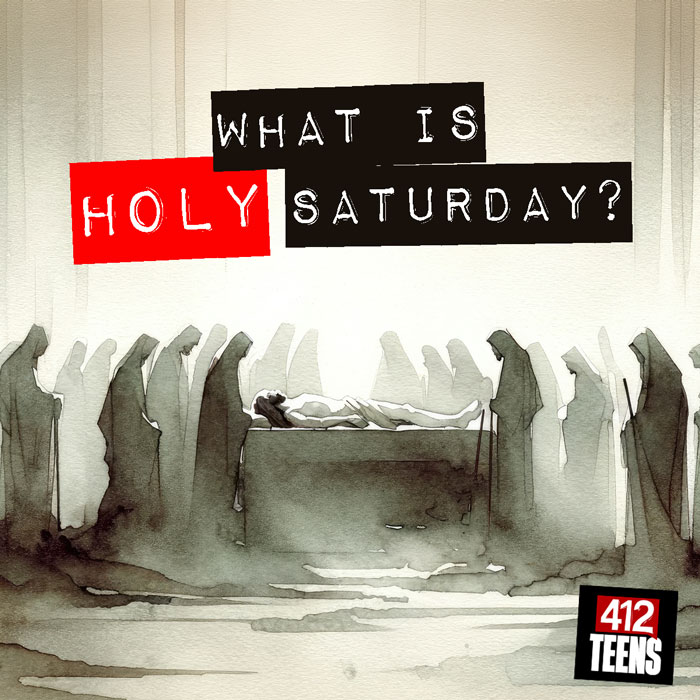
Holy Saturday commemorates the day after Jesus' crucifixion. As Jesus' body was still in the grave, some believers view this as the day Jesus "rested" after He sacrificed His life. It would have been a day of darkness for those who loved Him, for their beloved Jesus had seemingly been defeated by death.
Traditionally, those who recognize Holy Saturday treat the day with solemnity, reflecting on the terrible state the world would be in right now if Jesus had NOT come back to life on Easter Sunday. Catholic, Anglican, and Orthodox churches vary in their practices concerning Holy Saturday—sometimes cutting back on sacraments, avoiding certain celebrations, and encouraging meditation and fasting.1
What happened on Holy Saturday?
The Bible only touches on one exchange that occurred specifically on Holy Saturday, which started at sundown on Friday according to Jewish tradition. But let's go back to the day before to set the scene.
On the day we call Good Friday, after Jesus said, "It is finished!" (John 19:30) and died, His loved ones asked for His body to be taken down, then they prepared it to be placed in a tomb (Matthew 27:58-60; Luke 23:53-54; John 19:39-42). When they had completed the preparations, a stone was rolled in front of the tomb as per tradition (Mark 15:46). We can only imagine that there were many tears and perhaps they left to mourn the death of their Rabbi.
The next day, the chief priests and the Pharisees went to Pilate. They said, "Remember what that imposter said when he was alive? He said he'd come back to life after three days! We should make sure his disciples don't steal his body and tell people he has risen from the dead." So Pilate allowed them to put soldiers in front of the tomb to secure it. They even put a seal on the stone so there would be proof if it was moved (Matthew 27:62-66, paraphrased).
Should Christians commemorate Holy Saturday?
Christians are not required to observe specific holy days, as it's a matter of personal conviction (Romans 14:5-6). If we choose to observe Holy Saturday, we can do so, as long our actions are biblical and beneficial. Reflecting on the state the world before Jesus resurrected can inspire gratitude for the world we live in now—one in which Jesus is our salvation. We can accept the truth of the gospel of Jesus and be saved from the punishment of sin, which is spiritual death. With Jesus, we can be restored to God and receive eternal life (John 3:16-17).
As both historical and biblical accounts prove, the chief priests' and Pharisees' efforts to keep Jesus in the grave were useless. Jesus fulfilled every Messianic prophecy about Him—including the ones about Him rising from the dead! Holy Saturday is a day to remember this and thank Jesus for conquering sin and death forever.
RESOURCES: 1. "12 Things You Need to Know About Holy Saturday." Jimmy Akin, National Catholic Register, April 20, 2019. https://ewtn.co.uk/article-12-things-you-need-to-know-about-holy-saturday/
ALSO SEE:
- What are holy days?
- What is Ash Wednesday?
- What is Maundy Thursday?
- What is Good Friday?
- Did Jesus really die?
- Where was Jesus for the three days between His death and resurrection?
- What is Passover?
- What is an Easter Vigil?
- What is Easter Sunday all about?
- What are the origins of Easter?
- Is Jesus' resurrection really true?
- What does it mean that Jesus is the Lamb of God?


TL;DR
Holy Saturday falls between the day Jesus was crucified (Good Friday) and the day Jesus rose from the dead (Easter Sunday). This day can be observed as a solemn reflection on the terrible state the world would be in right now if Jesus had NOT come back to life on Easter Sunday. This kind of reflection can inspire gratitude for the world we live in now—one in which Jesus is alive and has given us the gift of salvation.

Writer: Grace Murphy
Grace is a passionate writer and musician who desires to radiate Christ's light in a generation of teens and young adults navigating their life in a world of spiritual darkness. Recent founder of Christian rock band Lighthouse Saints, she desires to spread the message of God’s truth and love through her songwriting and voice! Grace is also an aspiring freelancer who has worked professionally in writing, editing, and social media content creation. In her free time, Grace enjoys meeting new people, reading lots of books, jamming out with her friends, and writing (sometimes overly dramatic) poetry.
