What is Maundy Thursday?
Maundy Thursday, sometimes called Holy Thursday, takes place on the Thursday before Easter Sunday. "Maundy" means "command," so this day commemorates the commands Jesus gave His disciples at their last Passover Feast together (Luke 22:19-20). At this final meal, also called the Last Supper, Jesus took two specific actions that Maundy Thursday commemorates: washing His disciples' feet and establishing communion.
The Significance of Washing Feet
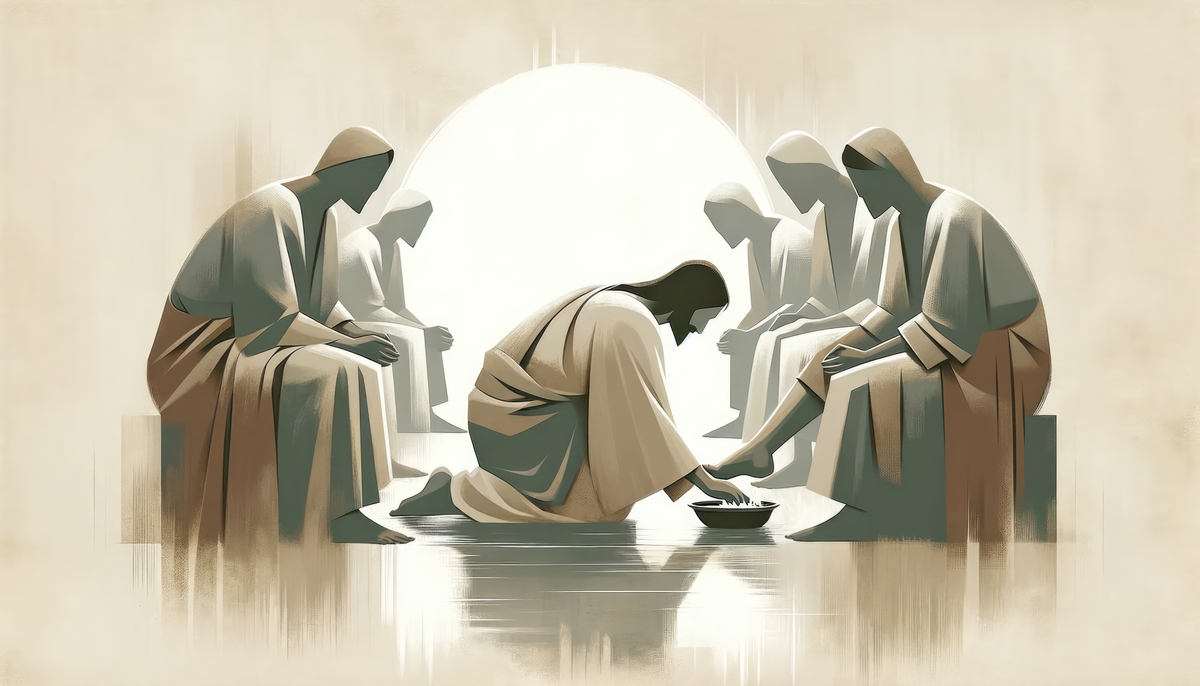
"[Jesus] got up from the table, took off his robe, wrapped a towel around his waist, and poured water into a basin. Then he began to wash the disciples' feet, drying them with the towel he had around him." —John 13:4-5 (NLT)
Walking on dirt roads in sandals made it important to wash one's feet before sitting down for a communal meal. The disciples had been arguing about who was the greatest, and none of them thought to do it—especially since there were no servants present (Luke 22:24-32).
When Jesus chose to put Himself in the role of a lowly servant, the disciples were shocked (John 13:1-17). Had their Lord really stooped to this dirty, unpleasant task? Simon Peter made a point to protest the idea, but Jesus told Him, "Unless I wash you, you won't belong to me" (John 13:6-10).
Jesus presented a practical example of humble servant leadership. Washing the disciples' feet did not demean Him, rather, it demonstrated the importance of loving one another and putting others' needs on the level with our own (1 John 4:9-12; Matthew 20:26-28).
The Significance of Passover
"The blood on your doorposts will serve as a sign, marking the houses where you are staying. When I see the blood, I will pass over you. This plague of death will not touch you when I strike the land of Egypt." —Exodus 12:13 (NLT)
The Passover Feast was a solemn Israelite holy day that commemorated when God rescued them from their enslavement by the Egyptians (Exodus 12). They obeyed God's command to slaughter a lamb, brush its blood on their doorframes, roast the entire animal, and then eat it with unleavened bread before morning (Exodus 12:6-10). By these actions, they were spared from the final plague brought upon Egypt (Exodus 11). God commanded the Israelites to continue observing this holy day every month for generations (Exodus 12:14-20).
Centuries later, Jesus and His disciples were observing the Passover Feast when Jesus established a new practice for Christians to follow: communion (Luke 22:19-21; Matthew 26:26-28). This was significant because it correlated with Passover's thoughtful observance of being delivered from a fate worse than death through a sacrifice. Jesus was to become the sacrificial lamb that would take away the sins of the world (Isaiah 53:7; John 1:29).

The Significance of Communion
"Jesus took some bread and blessed it. Then he broke it in pieces and gave it to the disciples, saying, 'Take this and eat it, for this is my body.' And he took a cup of wine and gave thanks to God for it. He gave it to them and said, 'Each of you drink from it, for this is my blood, which confirms the covenant between God and his people. It is poured out as a sacrifice to forgive the sins of many.'" —Matthew 26:26-28 (NLT)
Communion, also called the Lord's Supper, is now a vital part of Christian worship. Animals no longer need to be slaughtered as a temporary atonement for sin because Jesus IS the ultimate atonement (1 John 2:2). The observance of communion helps remind us that Jesus is the Holy Lamb, slain for our sin, and celebrates the salvation we receive as a result of His sacrifice (Romans 10:9; John 3:16-18).
Should I participate in Maundy Thursday services?
Some churches will have special services where believers will take part in foot-washing ceremonies as a way of taking a symbolic stance of humility and servant-leadership like Jesus did (John 13:34-35). They will also take communion, in remembrance of being saved from death and brought into newness of life through Jesus.
Observing Maundy Thursday is not required (Romans 14), though there is nothing wrong with participating in this commemoration either. Whether we do or don't commemorate this holy day makes no difference in how faithful we are. Our spiritual maturity is apparent by the love we show for one another (John 13:34-35)—not how we observe holy days.
"I am giving you a new commandment: Love each other. Just as I have loved you, you should love each other. Your love for one another will prove to the world that you are my disciples." —John 13:34-35 (NLT)
ALSO SEE:
- What are holy days?
- What is Ash Wednesday?
- What is Good Friday?
- What is Passover?
- What is Holy Saturday?
- What is an Easter Vigil?
- What is Easter Sunday all about?
- What are the origins of Easter?
- What does it mean that Jesus is the Lamb of God?
- What does the Bible say about humility?
- How can I be more humble?


TL;DR
Maundy Thursday, sometimes called Holy Thursday, takes place on the Thursday before Easter Sunday. "Maundy" means "command," so this day commemorates the commands Jesus gave His disciples at their last Passover Feast together (Luke 22:19-20). At this final meal, also called the Last Supper, Jesus took two specific actions that Maundy Thursday commemorates: washing His disciples' feet and establishing communion.

Writer: Grace Murphy
Grace is a passionate writer and musician who desires to radiate Christ's light in a generation of teens and young adults navigating their life in a world of spiritual darkness. Recent founder of Christian rock band Lighthouse Saints, she desires to spread the message of God’s truth and love through her songwriting and voice! Grace is also an aspiring freelancer who has worked professionally in writing, editing, and social media content creation. In her free time, Grace enjoys meeting new people, reading lots of books, jamming out with her friends, and writing (sometimes overly dramatic) poetry.
