Who was Saint Nicholas?
What comes to mind when you think of Santa Claus? A jolly old, bearded man in a red suit and black boots? Presents delivered in the night? A holiday movie that includes reindeer? For children, Santa Claus might be one of the most iconic symbols of the Christmas season.
While the magical parts of Santa Claus and the 20th century marketing tropes are made up, there's a beautiful little twist in his origin story. Santa's traditions and legends reach all the way back to a real Christian church leader who existed long ago.
Nicholas: The Original Santa Claus
Saint Nicholas lived from AD 270 to 343 in a city called Myra, which was in the region of modern-day Turkey (Asia Minor). Almost everything we know about him comes from secondary sources and legends. We do know that Myra was a real place though. The Bible records Myra as a location where the apostle Paul, who had been taken prisoner, changed ships during his trip to Rome to stand trial around AD 60 (Acts 27:5).
Nicholas served as a church bishop in this influential town throughout the middle of the 4th century. He became a priest at a young age and was well known for his generosity and kindness to the poor. It's likely his parents were wealthy, and when they died, he used his inheritance to bless others.
St. Nick: The Legends & Traditions
Some of our most favorite Christmas traditions were borne from the many different legends about Saint Nicholas. For example, according to legend, there was a man in Nicholas' community who had become destitute. He was unable to provide his three daughters with a dowry (an amount of money that a father pays when his daughter is to be married). Because of this, they had no hope of marriage and would likely have to go into prostitution to survive.
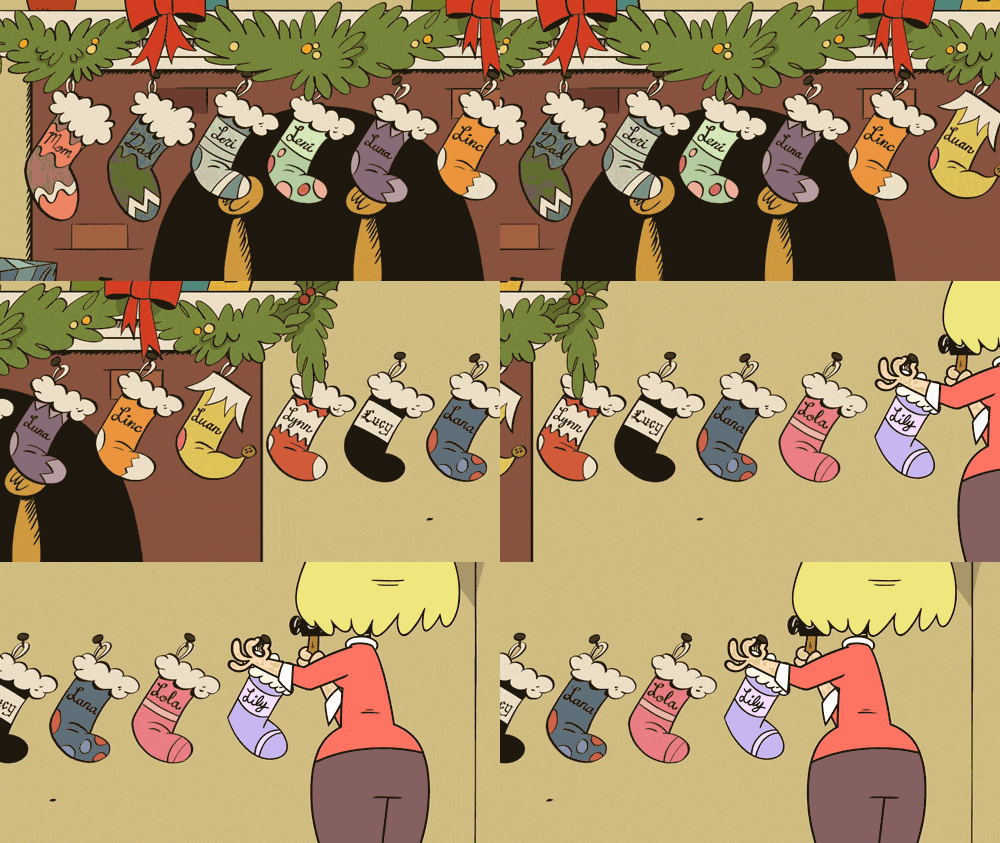
Nicholas heard of their need, so one night, he quietly went to their house and left them coins or bags of money to help them. Another version of this story says that he dropped his gifts down the family's chimney. Some stories say he threw them through a window and into the stockings that were hung up by the fire to dry. Yet other stories say he threw balls of gold into the stockings, which led to the tradition of putting oranges or tangerines as gifts in children's stockings.
After Nicholas Became a Saint
Nicholas died on December 6, AD 343, and the Roman Catholic church later declared him a "saint." According to Catholic tradition, a saint is an intercessor to whom believers can pray—though this is an unbiblical practice (1 Timothy 2:5). Biblically, the term "saint" refers to a believer who is set apart for the Lord and His kingdom. So, biblically, anyone who has trusted in Jesus as their Savior can be called a "saint" (1 Corinthians 1:2).
After Nicholas' death, celebratory traditions quickly arose to remember his life and spirit of generosity and kindness to others. These customs involved gift-giving, especially to children.
Sinterklaas & the Shoes
In the Dutch-speaking areas of Europe, Saint Nicholas was known as Sinterklaas. Their tradition was for children to leave their shoes out overnight. Their hope was that their shoes would be filled with candy and small gifts by a bearded man in a red suit—but only if the children had been well-behaved.
When Dutch immigrants came to the United States in the 1600s, they brought their Sinterklaas traditions, which eventually assimilated to the name "Santa Claus" around the 19th century.
The Naughty & Nice List
The notion that St. Nick makes a list and checks it twice started during the Middle Ages. Traditions said that he would ride a horse into every town each year to check up on people to see how they were doing, prior to the ultimate judgment by Jesus at the end of time (Hebrews 9:27; Revelation 20:11-15).

Reindeer & the North Pole
When the story of St. Nick visiting towns reached Norway, it changed from him riding a horse to riding reindeer because of how prevalent reindeer were in that part of the world. Since Norway is close to the Arctic Circle and the North Pole, this region became associated with Saint Nicholas' home1.
Nicholas: Defender of the Faith
One of the funniest legends around Nicholas has nothing to do with Christmas. The story involves the Council of Nicea and a heretic name Arius. The purpose of this council was to discuss and understand what the Bible taught about the nature of God, the nature of Jesus, and other essential doctrines.
The Council overwhelmingly affirmed the truth about the triune God—one God while also three co-equal and co-eternal Persons (Father, Son, Spirit). They asserted that Jesus is God, which meant He is eternal and not a "created" being.
Arius was a prominent person who had been teaching his belief that Jesus was NOT eternal, which meant that Jesus was a creation of God, and therefore NOT fully God. He brought his arguments to the Council, trying to convince the other church leaders of his lies. Legend says that Nicholas, who was in attendance, lost his patience with Arius' false teaching about Jesus' divinity and punched him in the face!

When you think about Santa Claus this Christmas, remember that many traditions people associate with him came from a real person. Saint Nicholas was a Christian who cared about people in his community. He sought out ways to practice generosity from his heart, bless others, and meet the needs of the destitute. These are all things Jesus taught as well (Luke 6:38), which is why it makes sense for them to be a part of the spirit of Christmas.
REFERENCES: 1. "How Did Saint Nicholas Turn into Santa Claus? - American Minute with Bill Federer." AmericanMinute.com-William J. Federer, 10 Dec. 2024, americanminute.com/blogs/todays-american-minute/how-saint-nicholas-turned-into-santa-claus. Accessed 3 Nov. 2025.
ALSO SEE:


TL;DR
Saint Nicholas (AD 270-343) was a Christian church leader in Asia Minor who cared about people in his community. He sought out ways to practice generosity from his heart, bless others, and meet the needs of the destitute. These are all things Jesus taught as well (Luke 6:38), which is why it makes sense for them to be a part of the spirit of Christmas.

Writer: Hanna S.
Hanna loves spending time with kids and teens. She enjoys being detectives with them to investigate God's Word to discover truths to answer any questions. She is the co-author of a newly published apologetics curriculum for children and teaches one online for highschoolers-adults. To learn more about her ministry you can visit networkerstec.com. For fun, she likes to play Ultimate Frisbee, read historical fiction, and paint.
